The work most of us never see…
If you turn on the faucet in Indian Head and clean water comes out, if your street gets plowed after a storm, if a fallen tree gets cleared, if a sewer backup is handled before it becomes a neighborhood crisis, then you have already felt the impact of Eric Woodland and the Public Works team.
Most of us experience their work without ever seeing the people behind it.
That is exactly why this story matters.
We launched the “Profiles in Service” series to help our town reconnect with the neighbors whose daily labor makes community life possible. It is easy to notice town government only when something goes wrong. It is harder, and more important, to notice the steady hands that keep problems from reaching our front doors in the first place. For us, that kind of awareness is not just storytelling. It is part of how we build gratitude, stronger civic understanding, and a deeper sense of “We.”
Eric Woodland is exactly the kind of public servant this series was created to honor.
A lifetime rooted in Indian Head
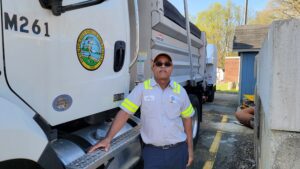
Public Works Superintendent Eric Woodland with the Town’s Heavy Equipment
Eric has worked for the Town of Indian Head since 1989. He started as a foreman, but his story begins even earlier than that. As a young man, he worked after school and on weekends with a local contractor, learning around heavy equipment and job sites alongside his father. When that chapter ended and a position opened with the town, Eric stepped into public service and never really left. Now, nearly four decades later, he is still here. And thank goodness he is.
He grew up in Indian Head. He built his life here. He raised a family here. He briefly spent time in the Waldorf and La Plata area, but came back home and stayed. In a world where many jobs are stepping stones, Eric’s career tells a different story. This is not a man who happened to work in Indian Head. This is a man who has spent much of his life investing in the place that shaped him.
That kind of longevity matters.
In a small town, institutional knowledge is a form of service all by itself. It means knowing where the old lines run. It means remembering how a system was built, which fix held, which one failed, and what corner of town tends to flood, freeze, back up, or break first. It means not having to guess when a problem starts underground in the middle of the night.
Eric carries that knowledge, and so does the team around him.
Eight people, an enormous responsibility
What began as a simple interview quickly revealed something much bigger. What sounds from the outside like “the Public Works Department” is, in reality, a very small team carrying an incredibly large share of the town’s daily burden.
Eric described it plainly: “There’s only eight of us, technically seven now.”
Those few people are responsible for a remarkable range of work. They maintain equipment and vehicles. They handle snow removal, road maintenance, water main breaks, sewer main breaks, sewer backups, storm drains, drainage ditches, tree removal, utility locating, and support for new water and sewer connections. They help keep parks and public spaces functioning. They respond to after-hours emergencies. They maintain aging infrastructure while still finding ways to support growth.
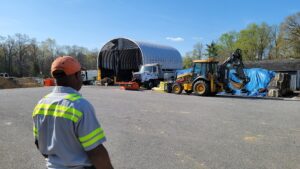
Overseeing Equipment, Salt Storage, and Raw Materials Necessary for Town Maintenance
And Eric is not describing that work from behind a desk.
One of the clearest impressions from our visit was that he is not a hands-off administrator. Even as superintendent, he is still doing the work itself. He talks about laying pipe, climbing into the hole when needed, helping monitor a job, and jumping from field work back into office tasks as Miss Utility tickets, calls, and emergencies come in. That is not symbolic leadership. That is working leadership.
At one point during our conversation, several utility-related demands came in while he was still walking through the current workload. That felt like a fitting snapshot of the job. Public Works is not a tidy list. It is a constant reprioritizing of whatever matters most right now.
As Eric put it, he does not have fifty people for one job. He has “one person for 50 jobs.”
Service does not stop at 5 p.m.
There is a version of town work that many residents imagine: scheduled crews, predictable hours, visible projects. Some of that is real. Much of it is not.
Public Works in Indian Head is also on-call work, emergency work, winter work, overnight work, and unseen work.
Eric showed us the call rotation. The team alternates seven days on and seven days off. At any hour, a call can come in for a water main break, a backup, a tree down, or some other urgent problem. If something happens at 3:30 in the morning, somebody puts on boots and goes. That is the expectation. That is the job.
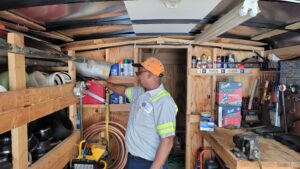
Inside the Custom Built, Portable Command Center for Emergency Maintenance On-Scene, Wherever the Town Needs
During snow events, the pace becomes even more intense. Eric described the recent storm when the snow did not soften and melt the way people hoped. Instead, the temperatures dropped, the moisture stayed, and what fell on our streets hardened into something like concrete. His crew ran multiple plow trucks, salt spreaders, loaders, and smaller vehicles, then went back again to clear intersections, school crossings, sidewalks, and access points for emergency services.
That work is physically hard. It is also mentally demanding. Every storm means route decisions, equipment decisions, manpower decisions, and tradeoffs. Some roads are privately maintained through homeowners associations, which means the town cannot simply plow everything residents assume it should. Some areas must be handled first for safety and access. Some complaints come from people who do not see the constraints, only the inconvenience.
That is the burden of invisible work. When it goes well, people move on with their day. When it does not, they notice immediately.
Making every dollar stretch
One of the most striking themes in both the interview and the yard tour was not just hard work. It was stewardship.
Eric and his team are deeply conscious of cost.
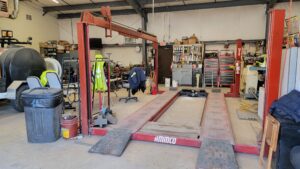
The Shop: What can be Repaired Is. Outsource Little, Repair and Reuse Wherever Possible
They repair what can be repaired. They reuse what can be reused. They build what they can build in-house. They avoid outsourcing when it makes financial and operational sense to do the work themselves. The Public Works yard itself tells that story. There are structures they built with their own hands, including salt storage, workspaces, and practical improvements designed to make operations more efficient over time.
That stewardship shows up everywhere. It shows up in old trucks still kept as backup because “old reliable” can still save the day when a newer computer-driven truck is down. It shows up in stocking the right parts so downtime is minimized. It shows up in welding, fabrication, and the willingness to get dirty instead of sending every problem somewhere else. It shows up in decisions to rent equipment only when needed, send it back in winter to control costs, and bring it back when the work resumes. It shows up in careful choices about when to contract work and when to handle it with town labor.
This matters because the town’s budget is not abstract. Every dollar spent on one urgent problem is a dollar not spent somewhere else. Eric knows that. His team knows that. The result is a culture that seems built around one basic commitment: make it work, make it last, and make every penny count.
That is not glamour. That is integrity.
Beneath our feet, around our homes, and all over town
The deeper we went into conversation with Eric, the more obvious it became that most residents only see a tiny fraction of what Public Works actually carries.
We notice a pothole. They see the road, the stormwater, the drainage path, the buried lines, the equipment needed, the staffing limits, and the cost.
We notice that water is on. They think about wells, pumps, mains, laterals, valves, aging hardware, underground surprises, and what happens when rusted parts finally fail.
We notice that new homes are being built. They think about taps, grinder pumps, utility locating, service capacity, and what it means to support a growing footprint with a very small crew.
We notice that a park looks clean or a public space is ready for an event. They have already been there, often before dawn, setting up, cleaning up, fixing something, or getting called away to something more urgent.
We notice Public Works trucks or activities about town: The epicenter is largely out of the public eye, and the Public Works facility is dense, busy, and always in motion. There is no idle calm. There is just the next thing that needs doing, and the next thing after that. Over time, the backlog gets handled, but only because a small group of people keeps returning to the work.
The kind of leadership a small town depends on
There is something deeply encouraging about meeting a public servant who still speaks with pride about the work, still values the team, and still shows up ready to do the hard part himself.
Eric does not present the job as easy. He is candid about staffing pressure, budget limits, aging infrastructure, equipment challenges, and the constant churn of priorities. But he also speaks with a kind of steady realism that small towns depend on. The work must be done, so they do it. When the plan changes, they adjust. When a new crisis interrupts the old one, they secure what they were doing and move to the next need.
That is service in its most practical form.
It is not performative. It is not loud. It rarely gets applause. But it is faithful.
And in Indian Head, it is one of the reasons daily life still works.
Why this story belongs to all of us
We believe civic engagement is about more than meetings, agendas, or public debate. It is also about understanding the real people behind the systems that support our lives. When we know their stories, we are more likely to value their labor, treat them with respect, and see our town not as “them” and “us,” but as something we are all responsible for together.
Eric Woodland’s story reminds us that some of the strongest forms of leadership do not happen at a podium. They happen in a shop yard, on a plow route, over an open utility hole, beside a broken main, or on the end of a late-night call no one else wants.
They happen when somebody chooses, again and again, to serve the town they call home.
That deserves to be seen.
That deserves to be honored.
And maybe, if we let it, that kind of example can call something good out of the rest of us too: a little more patience, a little more gratitude, and a little more willingness to build this community together.
Together, we build a better Indian Head.